The History of Morse Code
How a painter's idea became the world's first electric language — from Samuel Morse's telegraph and the message "What hath God wrought" to the Titanic, the space age, and the amateur-radio operators who still send dots and dashes today.
The world before Morse code
For most of human history, a message could travel no faster than the person, horse, or ship carrying it. News of a battle or a birth might take weeks to cross a country. Signal fires, semaphore towers, and flags could flash a few pre-agreed messages over short distances, but there was no way to send arbitrary words quickly across long distances. The telegraph — and the code that made it usable — changed that almost overnight.
Samuel Morse and the electric telegraph
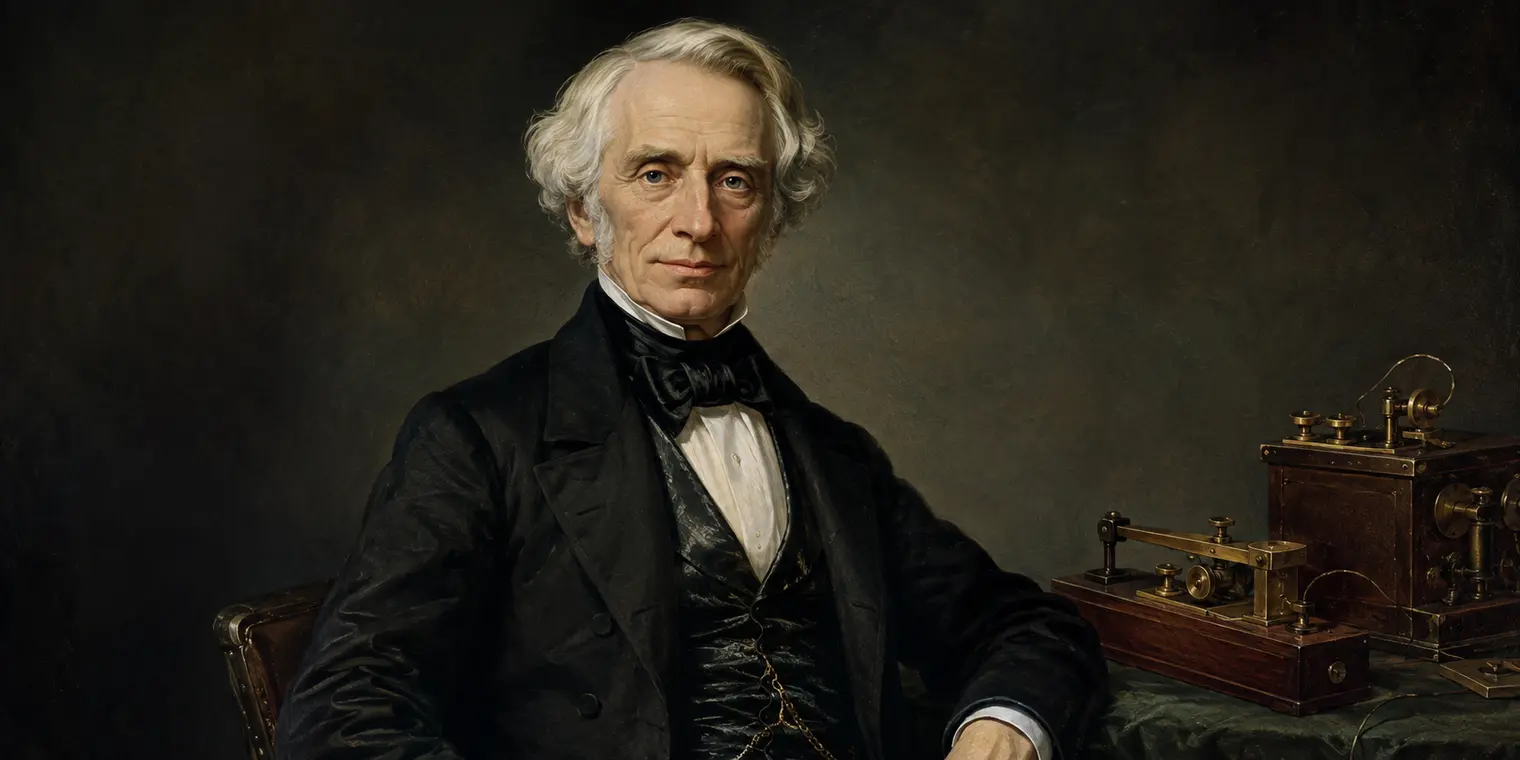
Samuel F. B. Morse was a successful portrait painter, not an engineer. According to his own account, the idea struck him in 1832 aboard a ship returning from Europe, during a conversation about electromagnetism. Grief may have sharpened the motive: years earlier, a letter announcing his wife's illness reached him too late, and she had died and been buried before he could return home. A faster way to send words became his obsession.
Morse was not alone — in Britain, William Cooke and Charles Wheatstone patented a competing telegraph in 1837. But Morse, working with the machinist Alfred Vail and the scientist Joseph Henry, developed a system that was simpler and cheaper: a single wire and a code of pulses. On 24 May 1844, Morse sent the first official message on the experimental Washington-to-Baltimore line — the famous words "What hath God wrought."
How the code worked
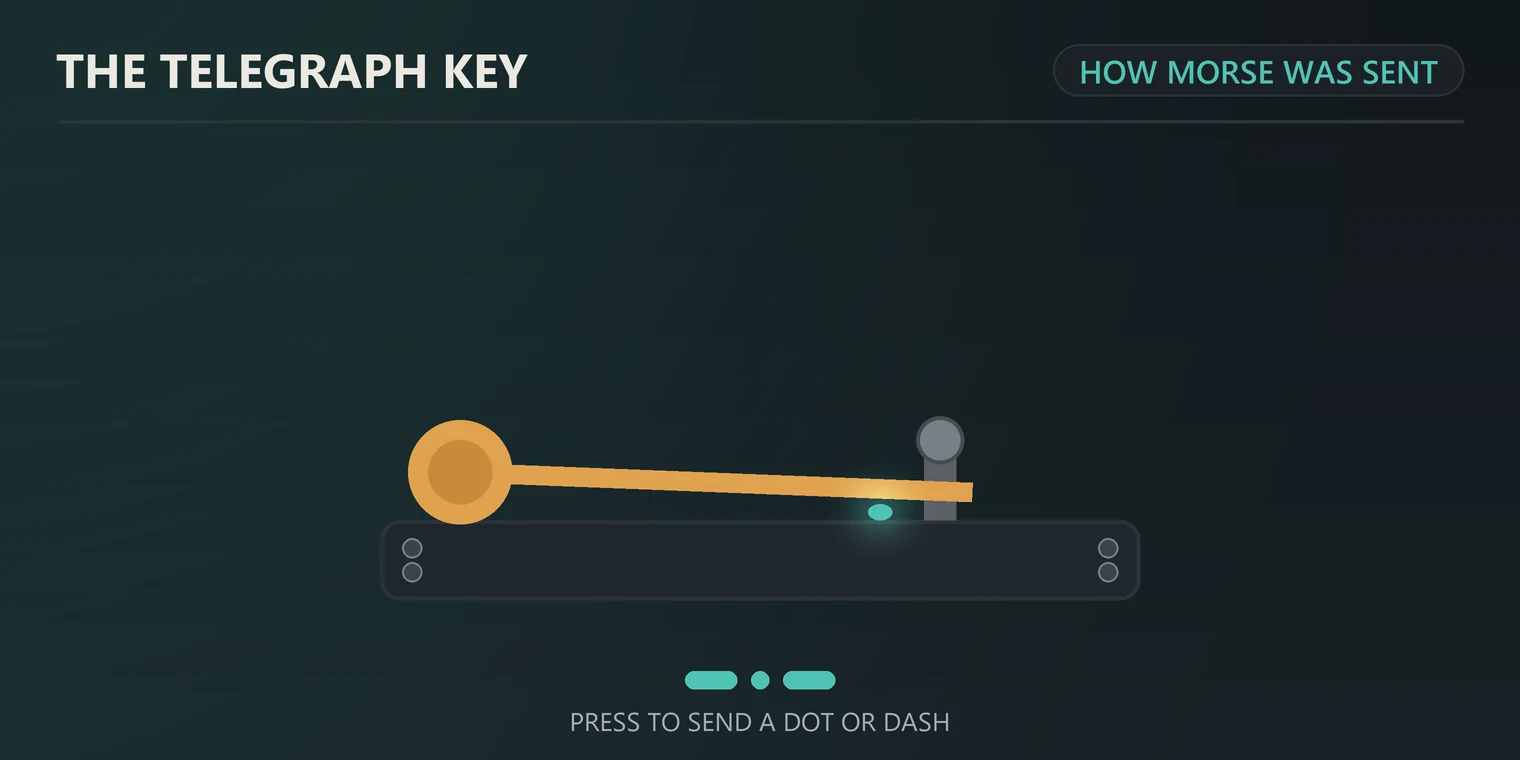
The genius was in the code, not just the wire. Instead of a separate signal for every letter, Morse and Vail assigned each character a short pattern of two elements — a brief pulse (a dot, ·) and a longer one (a dash, −). Common letters like E (·) and T (−) got the shortest patterns, so everyday messages sent faster. You can see the full set of patterns on our Morse code alphabet chart, or type a message and hear the rhythm in the Morse code translator.
American Morse vs. International Morse
The original "American Morse" used by railroad and landline operators had some awkward internal spaces and variable-length dashes. As the telegraph spread across Europe, a cleaner version was standardised in 1865 as International Morse code (also called Continental Morse). It's the version used for radio, aviation, and maritime work — and the one every modern chart, including ours, is based on.
The golden age of the telegraph
Within a few decades the telegraph knitted the world together. The first transcontinental line across the United States was completed in 1861, ending the Pony Express almost immediately. In 1866, after several failed attempts, a durable transatlantic cable linked North America and Europe, cutting message times between the continents from weeks to minutes. Whole industries — journalism, finance, railways — were rebuilt around instant long-distance communication.
Morse goes to sea — and SOS is born
When radio ("wireless telegraphy") arrived around 1900, Morse code was the natural language for it, and ships were its first great customers. Different companies used different distress calls until the world agreed on one simple, unmistakable pattern: ··· −−− ···. Its most famous use came in 1912, when the Titanic's operators tapped out distress calls into the freezing Atlantic night. Read the full story of that signal on our SOS in Morse code page.
Timeline at a glance
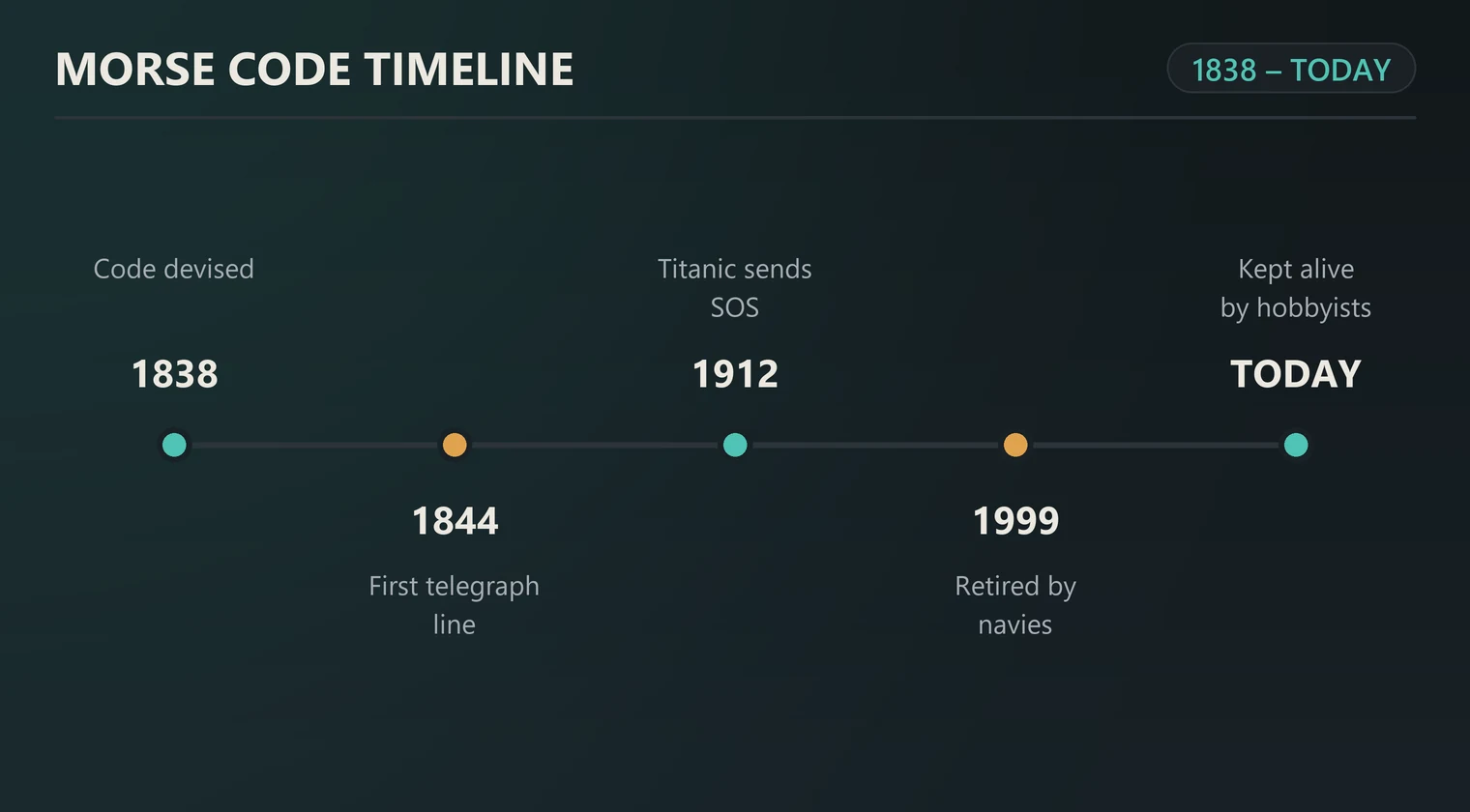
- 1832Morse conceives the idea of an electric telegraph while sailing home from Europe.
- 1838Morse and Alfred Vail publicly demonstrate the code and telegraph.
- 1844"What hath God wrought" — the first official telegram, Washington to Baltimore.
- 1861The transcontinental telegraph line spans the United States.
- 1865International Morse code standardised in Europe.
- 1866A lasting transatlantic cable connects two continents.
- 1908··· −−− ··· (SOS) becomes the worldwide radio distress signal.
- 1912The Titanic sends distress calls by wireless Morse.
- 1999Commercial maritime Morse retires as digital systems (GMDSS) take over.
- TodayAmateur radio operators and enthusiasts keep the code alive worldwide.
Decline — and why it never died
The telephone, and later teleprinters and digital radio, slowly replaced Morse for everyday commercial traffic. The formal end of an era came in 1999, when the maritime world officially switched to satellite-based distress systems, and France's coastal stations signed off with a poignant final message. But Morse code proved remarkably hard to kill. It needs almost no bandwidth, punches through noise and weak signals that would defeat voice, and can be sent by anything that can be switched on and off — a lamp, a buzzer, even a blinking eye.
Morse code today
Today Morse lives on in several places at once. Amateur (ham) radio operators use it to make contacts around the globe with tiny amounts of power. Aviation still identifies navigation beacons with Morse letters. It's a tool for accessibility, letting people with limited movement communicate through a single switch, and a favourite of scouts, survivalists, and puzzle-lovers. If the history has you curious to try it, start with our guide to learning Morse code, practise real vocabulary from the common words & phrases list, or share the fun with a younger learner using Morse code for kids.
Hear a piece of history
Type "WHAT HATH GOD WROUGHT" — or your own name — into the Morse code translator and press Play to hear the same dots and dashes that crossed those first telegraph wires in 1844. Read more stories on our Morse code blog, or learn about MorseTranslateCode.
Send a message the 1844 way
Convert any text to authentic International Morse code and hear it in dots and dashes — free, no sign-up.
Open the translator →